14 Jun 2026
Linking API Protocols with Responsive Support Frameworks Across Flexible Rate Structures in Medical Service Billing Networks
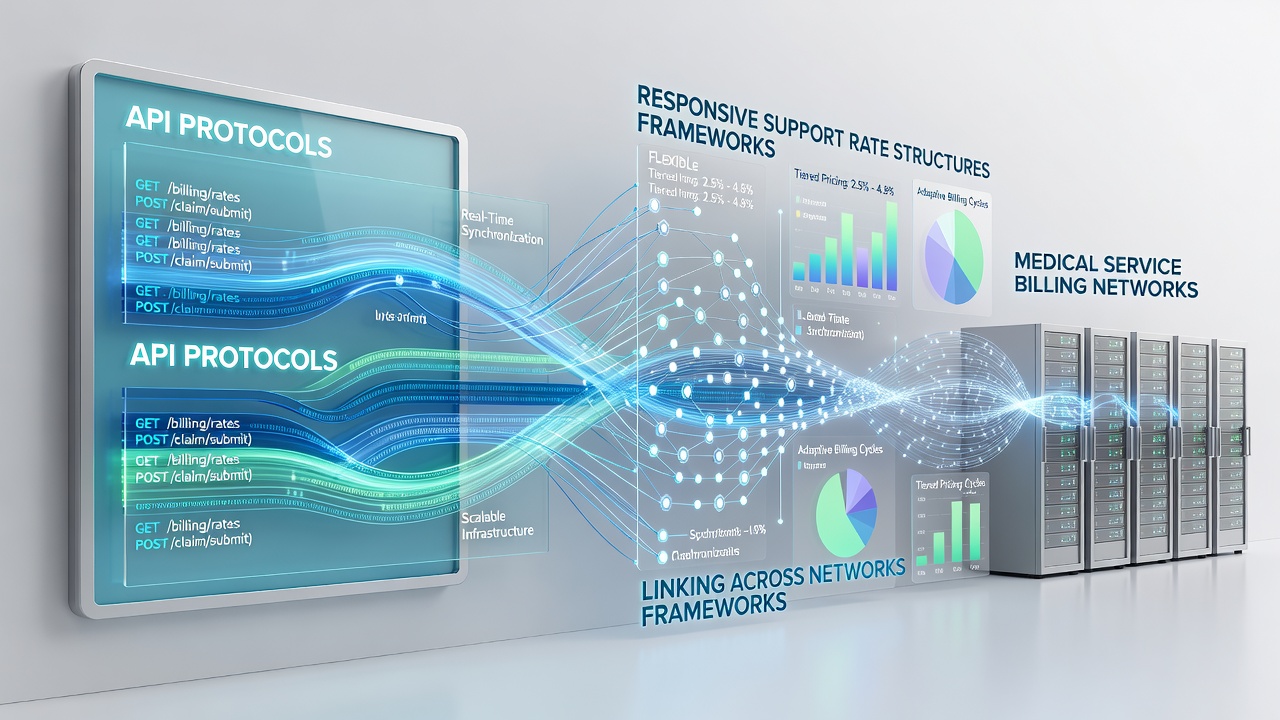 Medical service billing networks have grown more complex as providers handle multiple payers, varying reimbursement rules, and real-time claims processing demands. API protocols now serve as the connective tissue that allows billing platforms to exchange data with electronic health records, insurance verification tools, and revenue cycle management systems. These protocols standardize requests for eligibility checks, claims submissions, and remittance advice while maintaining compliance with regulations such as HIPAA in the United States and equivalent data protection standards elsewhere. Support frameworks operate alongside these APIs to address exceptions that automated processes cannot resolve on their own. When a claim encounters a coding mismatch or requires prior authorization clarification, responsive support teams use dedicated dashboards that pull live data through the same API connections. This setup reduces turnaround times because agents see the exact transaction state without switching between disconnected applications. Flexible rate structures add another layer because medical service providers often contract with payers under tiered fee schedules that change based on procedure volume, patient demographics, or seasonal adjustments. API endpoints expose these rate tables in machine-readable formats so billing software can apply the correct amounts automatically. Updates to rate schedules propagate through the network within hours rather than days, which matters when new fiscal year contracts take effect.
Protocol Standards Driving Interoperability
HL7 FHIR and X12 EDI remain the dominant standards that medical billing networks rely on for structured data exchange. FHIR resources handle patient demographics and clinical documentation while X12 transactions manage the financial side including claims and payment remittances. Developers map these formats through API gateways that enforce authentication, rate limiting, and audit logging at every step.
Research from academic institutions tracking adoption rates shows steady growth in FHIR-based implementations across hospital systems. As of June 2026, several regional health information exchanges report that more than half of their participating providers now expose billing APIs using FHIR profiles for coverage and claim responses. This shift enables smaller practices to connect directly with clearinghouses without maintaining legacy point-to-point interfaces.
Support Integration Patterns
Responsive support frameworks link into these API layers through webhook notifications and ticket management systems. When an API call returns an error code indicating missing documentation, the framework automatically creates a case record and assigns it to the appropriate specialist. Agents then access the original request payload through a unified console, eliminating the need to request the same information from the provider again.

Observers note that this pattern appears most frequently in networks serving multi-state provider groups where support staff must handle time zone differences and varying state Medicaid rules. The frameworks maintain audit trails that satisfy both internal quality metrics and external regulatory reviews.
Rate Structure Adaptability
Flexible rate structures require APIs to support versioning so that historical claims continue to process under the rules in effect at the time of service. Billing networks implement this through parameter-driven endpoints that accept effective dates and contract identifiers. When payers issue mid-year adjustments, the system applies new rates only to claims with dates of service after the change while preserving prior calculations for already adjudicated items.
Data from the Centers for Medicare & Medicaid Services indicates that networks using versioned API rate tables experience fewer post-payment reconciliation disputes. European counterparts, including systems aligned with the European Health Data Space, follow similar versioning practices to accommodate cross-border care reimbursement variations.
Security and Compliance Considerations
Every API connection in medical billing networks incorporates encryption in transit and at rest along with role-based access controls. Support frameworks inherit these controls so that agents can view only the data necessary for their assigned cases. Token-based authentication replaces shared credentials, and session logs feed into centralized monitoring platforms that flag anomalous access patterns.
Industry reports from organizations such as the Healthcare Information and Management Systems Society document continued investment in these controls as networks scale. Providers that adopted these layered approaches early report smoother audit outcomes when external reviewers examine claims data and associated support interactions.
Conclusion
Linking API protocols with responsive support frameworks across flexible rate structures creates measurable efficiencies in medical service billing networks. The combination allows automated processing to handle routine transactions while human expertise addresses edge cases without losing context or introducing delays. Continued standardization efforts and measured adoption of updated protocols position these networks to accommodate evolving payer requirements and regulatory expectations through 2026 and beyond.